



















Statement by the Executive President of the World Association for Development
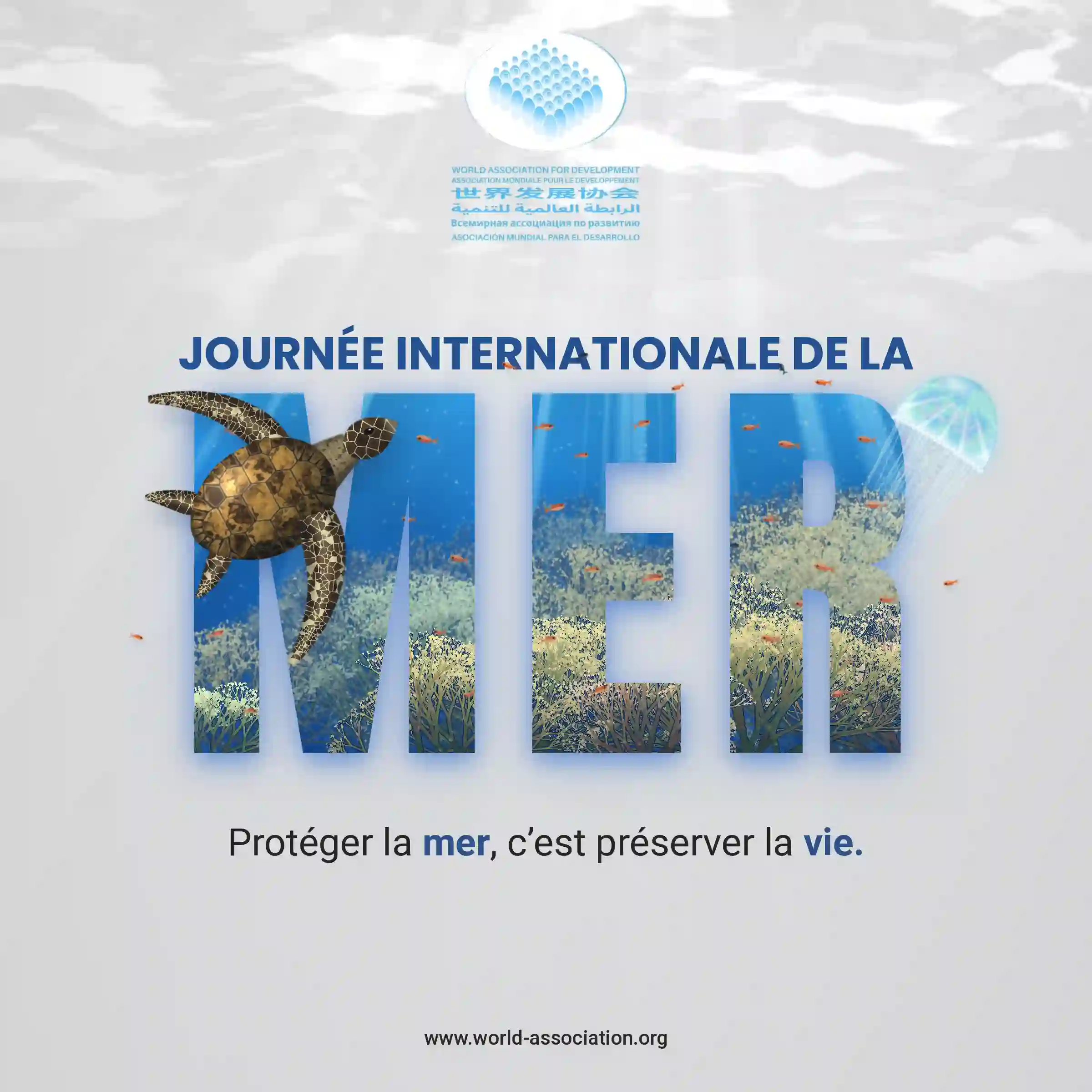
World Oceans Day, 24 September 2026
Making maritime excellence a reality for every nation
The world does not rely solely on the territories defined by national borders. It also depends on the maritime routes that connect economies, transport essential resources and ensure the continuity of trade between peoples. Although often out of sight of the general public, the sea is nevertheless one of the most crucial elements of global development.
When a shipping route becomes inaccessible, a crew is threatened or a port ceases to function, the consequences are never confined to the ocean. They affect markets, farms, industries, public services and households. Rising prices for food, fuel, fertiliser and basic necessities thus reveal a fundamental reality: any maritime crisis ultimately becomes an economic, social and humanitarian crisis.
The theme for World Maritime Day in 2026 and 2027, ‘From Policy to Practice: Promoting Maritime Excellence’, calls on the international community to take a clear-eyed look at the gap that remains between the rules adopted and their effective implementation. Over several decades, states have built up a substantial legal and technical framework. The challenge, therefore, is no longer simply to increase the number of commitments, but to ensure these are translated into tangible results in terms of workers’ safety, the reliability of port operations, the protection of the oceans and the resilience of supply chains.
The World Development Association considers that maritime excellence cannot be assessed solely in terms of the performance of ships, the speed of trade or the competitiveness of ports. It must also be measured by the global maritime system’s ability to protect human lives, guarantee access to essential goods, reduce economic vulnerabilities and preserve the resources on which future generations will depend.
This requirement is particularly relevant to developing countries. Many of them bear the brunt of maritime disruptions without having the infrastructure, funding, technology or institutional capacity needed to respond to them. Truly equitable maritime governance must enable them to strengthen their ports, train their professionals, modernise their regulatory frameworks and participate fully in the decisions that shape the sector’s future.
Moving from policy to practice also requires ensuring that the maritime energy transition does not create new divides. The decarbonisation of maritime transport, the use of less polluting fuels and the modernisation of port infrastructure are essential. However, their implementation must be based on solidarity-based cooperation, accessible funding and effective knowledge-sharing, so that environmental requirements become an opportunity for transformation for all countries, rather than an additional factor leading to exclusion.
The AMD thereforecalls on governments, the International Maritime Organisation, economic stakeholders, workers’ organisations, financial institutions and civil society to build a continuous chain of accountability, from the drafting of standards through to their day-to-day application. A convention that has been ratified but is inadequately implemented protects neither seafarers nor the oceans. A policy that is announced but lacks the necessary resources strengthens neither ports nor economies. An international commitment only becomes credible when it brings about concrete and sustainable change.
The sea must not become a space where the world’s rivalries are played out, but a domain where cooperation, the rule of law and shared responsibility prevail. Guaranteeing the freedom and safety of navigation, protecting the men and women who facilitate trade, preserving marine ecosystems and strengthening the resilience of the most vulnerable countries are the inseparable foundations of a single ambition.
On this World Oceans Day, the World Association for Development calls for us to move beyond mere intentions and into the realm of tangible results. Maritime excellence will truly come into its own when it is no longer merely enshrined in policy, but reflected in the safety of crews, the stability of supply chains, the vitality of coastal economies and the improved living conditions of peoples and communities.
Hugues GNIMADI
Executive President
World Association for Development (AMD)
For the sustainable progress of peoples and communities